Throughout the day, IBMers talked to students about math, science, Deep QA system Watson, which just won the heralded Jeopardy! match, the value of a college education, and what it was like to be an engineer. At lunchtime, Laura Clayton McDonnell, Vice President, Public Sector West IMT, joined a group of 70 high achieving students enrolled in AP Calculus and AP U.S. History, to reinforce the message of making the right choice to continue their education and the habits that are necessary for success at school and work. With over 600 students in 15 classes hearing the message about education, thanks goes out to Lynn Guest, Energy Coordinator for San Jose and Silicon Valley Lab, for organizing the successful event and for all of the IBMers who gave their time to inspire our youth to go to college and pursue a career in math and science.
Tuesday, March 22, 2011
IBMers visit San Jose high school
Throughout the day, IBMers talked to students about math, science, Deep QA system Watson, which just won the heralded Jeopardy! match, the value of a college education, and what it was like to be an engineer. At lunchtime, Laura Clayton McDonnell, Vice President, Public Sector West IMT, joined a group of 70 high achieving students enrolled in AP Calculus and AP U.S. History, to reinforce the message of making the right choice to continue their education and the habits that are necessary for success at school and work. With over 600 students in 15 classes hearing the message about education, thanks goes out to Lynn Guest, Energy Coordinator for San Jose and Silicon Valley Lab, for organizing the successful event and for all of the IBMers who gave their time to inspire our youth to go to college and pursue a career in math and science.
Friday, March 4, 2011
Rank aggregation research expert recognized by IEEE
The IEEE Computer Society has awarded its 2011 Technical Achievement Award to Ronald Fagin, Manager, Foundations of Computer Science at IBM Research - Almaden, "for pioneering contributions to the theory of rank and score aggregation."
What is "rank aggregation"?
Assume a set of "voters" and a set of "candidates." Each voter provides a list of the candidates, in order of preference. Rank aggregation is the problem of determining a consensus ordering (1st place, 2nd place, 3rd place, etc.), or sometimes simply 1st place. In case each voter provides not only an ordered list of his preferences for the candidates, but a numerical score for each candidate, then this problem is called "score aggregation". Again, the goal is to obtain a consensus ordering of the candidates.
Rank aggregation and score aggregation have many applications in numerous fields, including databases, economics, and information retrieval (where a search engine such as Google aims to provide the user with a “top k list,” say, the top 10 matches). As an example of rank aggregation, a potential home-buyer might have one ranking of a set of houses based on location, another ranking based on price, another ranking based on quality of construction, and so on. We can think of each of the houses as a candidate, and each criterion (such as location, price, and quality of construction) as a voter. Thus, there is one voter who focuses only on location, another voter who focuses only on price, and so on. In this case, rank aggregation would obtain an overall ranking of the houses that takes into account all of the criteria.
In a solely authored 1996 paper, Fagin introduced a new model for score aggregation, where there is a fixed scoring function, such as the median or the mean, and where the consensus ranking of the candidates is in order of their overall score, based on the scoring function; the goal is to obtain the top k winners. If the score of every candidate by every voter were known, it would in principle be straightforward to determine the top k winners by a simple computation. The challenge, as Fagin presented it, is to determine the top k winners while minimizing the number of database accesses. Fagin defined an algorithm (widely called "Fagin's Algorithm"), which he showed was optimal in a certain precise sense, and which greatly influenced future research on score aggregation.
In 2001, Fagin, with Amnon Lotem and Moni Naor, defined a new algorithm (the "Threshold Algorithm") for score aggregation, which he showed was optimal in an even stronger sense: not just in the worst case or the average case, but in every case! This paper won two important awards. First, it won the Best Paper Award at the prestigious ACM Symposium on Principles of Database Systems (a.k.a. PODS, which is the premier database theory conference), and has now been widely implemented. Second, this paper very recently won the PODS "Test-of Time" Award, for the paper from the 2001 PODS conference that is now judged, 10 years later, to have had the most impact.
Fagin has also explored other aspects of rank aggregation. For example, a 2003 paper by Fagin (with Ravi Kumar and D. Sivakumar) shows how to define a distance between top k lists, such as the distance between rankings by two different search engines, and is widely used in information retrieval settings.
Ronald Fagin is a member of the IBM Academy of Technology. He has won an IBM Corporate Award, eight IBM Outstanding Innovation Awards, an IBM Outstanding Technical Achievement Award, and two IBM key patent awards. He has published over 100 papers, and has co-authored a book on "Reasoning about Knowledge." He has served on more than 30 conference program committees, including serving as Program Committee Chair of four different conferences.
He received his B.A. in mathematics from Dartmouth College, and his Ph.D. in mathematics from the University of California at Berkeley.
Accomplishments include:
The IEEE Computer Society Technical Achievement Award is given for outstanding and innovative contributions to the fields of computer and information science and engineering or computer technology, usually within the past 10, and not more than 15, years. Contributions must have significantly promoted technical progress in the field. The award will be presented at an awards dinner on May 25 in Albuquerque, New Mexico.
Assume a set of "voters" and a set of "candidates." Each voter provides a list of the candidates, in order of preference. Rank aggregation is the problem of determining a consensus ordering (1st place, 2nd place, 3rd place, etc.), or sometimes simply 1st place. In case each voter provides not only an ordered list of his preferences for the candidates, but a numerical score for each candidate, then this problem is called "score aggregation". Again, the goal is to obtain a consensus ordering of the candidates.
Rank aggregation and score aggregation have many applications in numerous fields, including databases, economics, and information retrieval (where a search engine such as Google aims to provide the user with a “top k list,” say, the top 10 matches). As an example of rank aggregation, a potential home-buyer might have one ranking of a set of houses based on location, another ranking based on price, another ranking based on quality of construction, and so on. We can think of each of the houses as a candidate, and each criterion (such as location, price, and quality of construction) as a voter. Thus, there is one voter who focuses only on location, another voter who focuses only on price, and so on. In this case, rank aggregation would obtain an overall ranking of the houses that takes into account all of the criteria.
In a solely authored 1996 paper, Fagin introduced a new model for score aggregation, where there is a fixed scoring function, such as the median or the mean, and where the consensus ranking of the candidates is in order of their overall score, based on the scoring function; the goal is to obtain the top k winners. If the score of every candidate by every voter were known, it would in principle be straightforward to determine the top k winners by a simple computation. The challenge, as Fagin presented it, is to determine the top k winners while minimizing the number of database accesses. Fagin defined an algorithm (widely called "Fagin's Algorithm"), which he showed was optimal in a certain precise sense, and which greatly influenced future research on score aggregation.
In 2001, Fagin, with Amnon Lotem and Moni Naor, defined a new algorithm (the "Threshold Algorithm") for score aggregation, which he showed was optimal in an even stronger sense: not just in the worst case or the average case, but in every case! This paper won two important awards. First, it won the Best Paper Award at the prestigious ACM Symposium on Principles of Database Systems (a.k.a. PODS, which is the premier database theory conference), and has now been widely implemented. Second, this paper very recently won the PODS "Test-of Time" Award, for the paper from the 2001 PODS conference that is now judged, 10 years later, to have had the most impact.
Fagin has also explored other aspects of rank aggregation. For example, a 2003 paper by Fagin (with Ravi Kumar and D. Sivakumar) shows how to define a distance between top k lists, such as the distance between rankings by two different search engines, and is widely used in information retrieval settings.
Ronald Fagin is a member of the IBM Academy of Technology. He has won an IBM Corporate Award, eight IBM Outstanding Innovation Awards, an IBM Outstanding Technical Achievement Award, and two IBM key patent awards. He has published over 100 papers, and has co-authored a book on "Reasoning about Knowledge." He has served on more than 30 conference program committees, including serving as Program Committee Chair of four different conferences.
He received his B.A. in mathematics from Dartmouth College, and his Ph.D. in mathematics from the University of California at Berkeley.Accomplishments include:
- Winner of the 2004 ACM SIGMOD Edgar F. Codd Innovations Award, a lifetime achievement award in databases, for "fundamental contributions to database theory"
- IEEE Fellow for "contributions to finite-model theory and to relational database theory"
- ACM Fellow for "creating the field of finite model theory and for fundamental research in relational database theory and in reasoning about knowledge"
- AAAS Fellow for "fundamental contributions to computational complexity theory, database theory, and the theory of multi-agent systems"
- Named Docteur Honoris Causa by the University of Paris
- Named "Highly Cited Researcher" by the Institute for Scientific Information
- Recipient of Best Paper awards at the 1985 International Joint Conference on Artificial Intelligence, the 2001 ACM Symposium on Principles of Database Systems, and the 2010 International Conference on Database Theory
The IEEE Computer Society Technical Achievement Award is given for outstanding and innovative contributions to the fields of computer and information science and engineering or computer technology, usually within the past 10, and not more than 15, years. Contributions must have significantly promoted technical progress in the field. The award will be presented at an awards dinner on May 25 in Albuquerque, New Mexico.
Saturday, February 19, 2011
Almaden mathematician named AAAS Fellow
IBM researcher Phokion Kolaitis was recently elected Fellow of the American Association for the Advancements of Science (AAAS) - an esteemed honor in which the organization's council elects those whose "efforts on behalf of the advancement of science or its applications are scientifically or socially distinguished." Dr. Kolaitis, recognized for his "distinguished contributions to logic in computer science and to the principles of database systems", always had a knack for math and logic. I spent some time with him to talk about this accomplishment, fueled mostly by, as he puts, "The drive for knowledge. I always had this curiosity and passion for advancing the frontier of knowledge."
And passion was a common theme in the discussion of Phokion's academic and career achievements. By high school, the Greece native had already decided he wanted to pursue mathematics. Once he entered University of Athens as an undergraduate, he felt science was what interested him, but that mathematics was the underlying basis for all things scientific. As he excelled in the university, he found himself focusing on the foundations of mathematics and, in particular, on mathematical logic. After completing his Ph.D. in Mathematics from UCLA, his interests evolved to applications of logic to computer science with particular emphasis on the connections between logic and databases. He became a professor of computer science at UC Santa Cruz and later on spent four years at Almaden as a research staff member and senior manager of the department of computer science principles and methodologies, also known as the "theory group."
"One of the reasons I wanted to come to IBM from academia was because I wanted to work on the foundations of information integration," explained Phokion, "in an area called schema mappings and data exchange." This area of study focuses on trying to develop methods and tools for restructuring data organized under one format into data organized into another. "It's a very old but recurrent problem in databases. With other colleagues at Almaden, we developed a framework for studying this problem that, in turn, facilitated the development of tools to ease the challenges." This work was recognized by IBM Research as an outstanding accomplishment, while at the same time some of the papers published on this topic have received hundreds of citations.
Outside of his career, Phokion has an uncommon hobby:
collecting fountain pens. His collection features about 250 pens, mostly vintage pens from the United States, Germany, and the UK, but also modern pens from France, Italy, and Japan. His favorite and most precious pen is his father's - a Parker '51 with a rare broad nib.
Phokion keeps a close relationship with his children, both of whom are pursuing medical careers - his daughter Irini is currently a first-year pediatric resident at the Children's Memorial Hospital in Chicago after earning her MD at Georgetown University and his son Nicholas is a third year medical student at UC San Diego. Phokion is a fan of classical music and enjoys Greek poetry, citing his favorite poet as George Seferis, the winner of the Nobel 1963 Nobel Prize for Literature. Seferis captivated Phokion - as he says "Seferis' speech at the Nobel Banquet encapsulates my own feelings about the Greek language, poetry and the human condition."Phokion will be presented the AAAS Fellow award during a recognition dinner in Washington, D.C. on February 19, 2011.
Friday, February 18, 2011
Great minds gather at Berkeley's Watson viewing event
The following post was written by guest contributor Steve Demello, CITRIS' Healthcare Director at UC Berkeley.

Some 300 enthusiastic students, faculty and researchers came together at Sutardja Dai Hall, the headquarters of the Center for Information Technology Research in the Interest of Society (CITRIS) at the University of California Berkeley, to watch and discuss the final episode of the Jeopardy! Challenge featuring IBM’s Watson platform. The event, distributed throughout the building and on the Internet with streaming video, included presentations and commentary about the event itself, Watson, and the future it portends for Natural Language Processing (NLP).
The event began with a welcome from Professor Paul Wright, Director of CITRIS, who underscored the importance of the Challenge and applauded IBM for its achievement. Jean Paul Jacob, CITRIS Senior Advisor and a career IBM executive, entertained the audience with a “pregame” presentation on the structure of the Jeopardy! game, the evolution and structure of Watson, and a summary of the first two days of competition.
Dr. Jacob was joined onstage by two distinguished commentators – Professor Shankar Sastry, Dean of the UC Berkeley College of Engineering, and Dr. Horst Simon, Deputy Director of the Lawrence Berkeley National Laboratory – on a set mimicking the game show itself, including Berkeley’s own version of Watson, dubbed “Chaplin”. Drs. Sastry and Simon commented before, at breaks during, and after the broadcast about the game, the technology, and future implications. They were joined in discussion by an engaged audience that included Professor David Patterson of the UC Berkeley Computer Science department and Michael Stewart, a former Jeopardy! champion.
The event concluded with reflections from Drs. Sastry and Simon, and discussion with the audience. Both commentators agreed that Watson represents a significant step forward in leveraging NLP, and that the capabilities demonstrated on Jeopardy! will be applied to a variety of areas, such as customer service. Both praised the “human ingenuity” at the heart of the technology, and Dr. Simon urged the group to consider this as an evolutionary step in a process that began in the 1940’s and 1950’s with early breakthroughs in computation. The commentators and audience both expressed their hope that IBM will share as much as possible with the broader research community, so that it can learn from what has been accomplished and to drive this exciting area of research forward.
Perhaps Professor Sastry best summed up the evening when he said that, as a technologist, “this was more exciting than the Super Bowl … with better ads.”
Thursday, February 17, 2011
Man vs Machine? Almaden friends and family gather for Watson's championship showdown

Watson wins!!!
Watson had the whole world engaged during its 3-day match against Jeopardy's best two contestants, Brad Rutter and Ken Jennings. The Almaden lab was host to over 200 IBMers and their friends and families on the night of the finale, and witnessed Watson battle its way to the winning spot, earning $1 million dollars for charity!
Here are some clips of the buzz before the game:
Friday, January 28, 2011
Silicon Valley IBMers bring expertise to Sri Lanka
IBM’s Corporate Service Corps program gives IBMers the opportunity to work on community-driven and economic development projects in strategic emerging countries for a month. CSC participants apply their professional skills to collaborate with clients and deliver value on large initiatives, such as strategic planning and educational access. Two Silicon Valley IBMers recently returned from their overseas assignment, and shared their story with us.Maria Román and Jennie Cobb were part of the first two teams engaged on CSC assignments in Sri Lanka. Maria, one of nine IBMers who made up Sri Lanka Team 1, participated on a project to execute an environmental analysis of the University of Moratuwa Department of Computer Science & Engineering (CSE), an institution struggling to obtain regional and international recognition. Jennie was part of the ten-person Sri Lanka Team 2, and she participated in a high-level study of the government’s infrastructure needs through the Information and Communication Technology Agency (ICTA).
What was IBM’s role on your projects?
MR: The CSE Department needed help in developing a five-year strategic plan aligned with the University’s 25-year vision. With the limited time we had in Colombo, we had to refine the statement of work to conduct a comprehensive as-is state (SWOT) assessment and a comparison of the department against five other highly-ranked Asian and international computer science departments. CSE will use the results of this analysis, which includes recommendations for strategies and actions the department can take, to create their five-year strategic plan. An important tie-in is that there are a lot of CSE graduates who fill key roles in technology and government. Helping to improve the CSE Department definitely has a concrete impact on how the talent pool is developed for the technology industry as a whole.
JC: In Sri Lanka, there is no consolidated government data center, capable of meeting today’s enterprise requirements. Government agencies must independently support and maintain their own small IT infrastructure needs, which is expensive and limits their ability to share information throughout the government. Our mission was to propose implementation strategies for a private government cloud able to support the government re-engineering initiatives. Our other challenge was to recommend sustainable funding options. The majority of the funding for the government’s IT initiatives comes from World Bank, which does not invest in multi-year infrastructure projects such as this.
What was the result of your work? MR: After interviews, research and analysis, we identified and recommended 10 key focus areas for the CSE Department to consider pursuing over the next five years as part of the detailed strategic plan that they will develop. We identified actions in areas such as building their research capability, defining a recruitment and retention strategy, conducting a detailed review of their post-graduate programs and creating a marketing plan for the department.
JC: After consulting with key government stakeholders, we formulated and delivered a set of recommendations for their initial cloud computing environment. We identified processes and tools to mitigate their security concerns. We presented a business case for a Green data center and the benefits of using virtual desktops to reduce the total cost of ownership for their government workstations. Most importantly, we recommended a strategy for sustainable funding using a public private partnership. The other exciting outcome of our CSC experience is that it helped identify IBM as a strong services provider.
What were some of the biggest challenges you faced?
MR: When you get your statement of work before you go in-country, you get overwhelmed by the scope. The initial scope was so big, there was so much that needed to be done, and you can’t really start working until you get there. The challenge was to establish rapport with the client very quickly, then collaborate and refine the scope to what would provide the biggest impact while we were there. Also, since we were the first team, there was a lot of focus on us and our projects. We were very aware of the expectations – and so another challenge was managing and meeting those expectations at the same time.
JC: The most challenging part was delivering on a large scope of work, while at the same time, becoming more knowledgeable on cloud. It was somewhat intimidating at first to know that our project impacted an entire country, but once we refined the scope of work and created a project plan, we realized it was manageable.
What did you hope to gain from this experience?
MR: Prior to leaving for Colombo, I jotted down some goals for myself for this experience. I wanted to successfully represent IBM as an ambassador, exceed our clients’ expectations, experience Sri Lanka fully and discover something new about myself while being out of my comfort zone and working on a project in an emerging market. Plus, I wanted to make a personal connection with at least one of my teammates.
JC: It was extremely important for me to be able to apply my IT and business skills on a project that could have a positive impact on society – in this case, on the citizens of Sri Lanka. I’ve also drawn a lot of motivation from being a mentor within IBM – if I could help impact one person in IBM and have an exponential impact on his organization, what would result from my work for an entire country? Personally, I also wanted to experience Sri Lanka and adapt to the culture to the fullest extent.
Did you do that?
MR: Apart from the fact that we felt we exceeded our clients’ expectations, I feel that I really made a personal connection with not just one, but all eight of my team members. We were each other’s family while we were there. I also found that I could thrive, even out of my comfort zone – that I could be self-confident even in an ambiguous situation like this. Ultimately, the experience strengthened my desire to pursue more non-profit opportunities. I have this dream to set up a non-profit in my native country, the Philippines, and this experience helped me to better appreciate my east-west duality.
JC: I experienced Sri Lanka to the fullest extent possible! I found Sri Lanka full of warm people, smiling faces, unbelievable energy, rich colors, incredible sights and history, delicious food and most importantly, amazing optimism. “Potential” is a word that resonates in my mind about nearly every experience I had in Sri Lanka.
MR: I’ve been at IBM for almost 15 years. This experience is really something that makes me more proud to be an IBMer. The whole experience was much like my 4½ -hour bus ride from Dambulla back to Colombo – unpredictable, crazy, zigzagging, crowded, hot…in an old, decaying bus…but if you kept your eyes open, you’d see the beautiful countryside and be blessed by the honest smile of the Buddhist monk sitting beside you.
Maria Roman is an Organizational Change Consultant and Growth Play Learning Lead in Cloud Computing and Jennie Cobb is a Certified IT Specialist. Read a blog post from Jennie here.
Picture captions, top to bottom:
The Galle Face Green in Colombo is alive with energy from vendors, school girls, kite flyers and other visitors each day at dusk.
IBM CSC Sri Lanka Team 1 at the IBM Dinner Event, Taj Samudra Hotel in Colombo
First row, L-R: Anja Elsagir, Orla Duffy, Riddhi Sengupta, Silvia Di Girolamo, Maria Román
Second row, L-R: Felipe Piccirilo, Stefan Chrobot, Martin Mikulas, Chad Cracknell
A shopping excursion at an open market in Kandy yields a lesson in bargaining and an introduction to unfamiliar delicious tropical fruits. (Jennie Cobb, right)
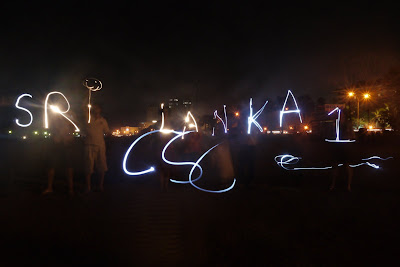
IBM CSC Sri Lanka Team 1's attempt at Light Art, Galle Face Green, Colombo
Tuesday, January 18, 2011
Community: IBMer helps students achieve big dreams through MESA
As a 7 year old, IBM researcher Andy Kellock loved math; he always found it easy and imagined growing up to be a jet fighter pilot. Hanging on to that dream through high school, he aspired to attend the Air Force Academy.
“Broken-hearted after not being selected, I was advised to go to college and get a BS in math or physics, and then re-apply for the Air Force,” laments Kellock. “I did, but by then my tastes had changed; the Vietnam War had just ended and I didn’t want to join anymore.”
Instead, Kellock, the top physics undergraduate in his college class, received a government scholarship to grad school and eventually earned his Ph.D. in physics from LaTrobe University in Melbourne, Australia.
Now, the IBM physicist of 24 years has another accolade to add to his list – Kellock is chairman of the Industry Advisory Board for MESA (Mathematics Engineering Science Achievement), a California-based program that seeks to prepare and motivate educationally disadvantaged students to pursue successfully college-preparatory coursework, promote careers in math & science, and develop their pre-professional & leadership skills.
And the success rate locally has been astounding. According to Kellock, 80% of students in the MESA program attend a 4-year college. The percentage of non-MESA students that go on to a 4-year? 16.
“The students in MESA are typically economically challenged and many times, the first in the family to go to college,” said Kellock. “If they're lucky enough to be in the program since elementary school, it's not even a question that they're going to go to college.”
Joining the MESA family over 20 years ago, Kellock meant only to help out a colleague, IBMer Nabil Saade, by volunteering for MESA Day – an event held each year at San Jose State, on a Saturday, that provides students a competitive platform to exhibit a math or science based project. Designed to help students develop a mastery of academic skills over time, expose them to college campuses and laboratories and to build self-esteem and confidence, MESA Day turned out to be the hook for Kellock – he ended up taking over the MESA Day Bridge Competition and has been supporting it ever since.
With the grassroots efforts and passion for the program that Kellock has put forth over the years, IBM has become a regular supporter of MESA, by providing monetary donations, an active volunteer base, judges for various competitions and a location for MESA Industry Day.
Each year, on Industry Day, Kellock brings a group of MESA students in to IBM Research – Almaden to show them things like moving atoms, how colored water is filtered into clear drinking water and even a few other surprising things that caught the attention of the students – like automatic doors. “Things that are trivial to us just blow them away,” said Kellock. “Their schools are sometimes so shabby. It’s exciting just to see the inside of these big buildings alone.”
As chairman of the Industry Advisory Board, Kellock plans to keep instilling the value of this program to Silicon Valley corporations to obtain partnership funding and donations. According to him, volunteers are easy to find, but serious money is not – a few thousand dollars a year is hardly enough to keep the programs alive, and with the state education budget cuts, MESA is going hard to school districts and principals, hoping that they allocate another year’s worth of funding to the program.
As tough as it is, the MESA family and associates truly believe in the goodness of the program – and they have the numbers to prove their success. The San Jose State-based program supported 16 schools and over 1,000 students in the South Bay. Kellock expects the program to grow to 19 schools and 1,300 students next year.
“Volunteerism is great. It makes for a happier employee and it’s been a very rewarding experience. My heart goes out to the teachers, especially in this educational and financial climate. We’re very luck to have them – they’re helping build our future workforce. If I can help them build that, then I feel I’ve done a good thing.”
Update: 12/8/11
OscarPorterMESA
More about MESA:
Image captions:
Top right: Andrew in his lab at IBM Research - Almaden, holding a commemorative plaque from the Mayor of San Jose, honoring his contributions to the community.
Bottom left: Students in the San Jose-based MESA program thank Kellock for coaching them through one of many technology fairs, supported by individuals like Kellock, and corporations like IBM.
More on SJSU MESA Schools Program: http://www.mesasjsu.org
MESA: http://www.ucop.edu/mesa/
Subscribe to:
Posts (Atom)